
Preparing for the ICF ACC Credential Exam can feel overwhelming if expectations are unclear.
The good news: this exam does not assess advanced mastery.
It validates your foundational understanding of coaching according to ICF standards.
This article is designed to help you prepare efficiently and confidently. You will find:
- a clear explanation of the ACC exam,
- a practical readiness checklist,
- a structured 4-week study plan,
- and the most common mistakes candidates make — with concrete ways to avoid them.

What Is the ICF ACC Credential Exam?
The Associate Certified Coach (ACC) Exam is a mandatory written assessment required by the International Coaching Federation (ICF) to obtain the ACC credential.
It evaluates your understanding of:
- the ICF Definition of Coaching,
- the 8 ICF Core Competencies,
- the ICF Code of Ethics,
- and the professional boundaries of coaching.
This is a knowledge-based multiple-choice exam, not a performance evaluation.
Its purpose is to confirm that you can think and decide as an ICF-aligned professional coach.
ICF ACC Exam Format and Structure
Before preparing content, it is essential to understand how the exam works:
- 60 multiple-choice questions
- 90 minutes total duration
- 4 answer options per question
- No negative marking
- Passing score: 460 (scaled score)
The exam is delivered online or in a Pearson VUE test center, depending on your selection.
ACC Exam Readiness Checklist
Core Coaching Knowledge
- I can clearly explain the ICF definition of coaching in my own words
- I understand the intent behind each of the 8 Core Competencies
- I can identify which competency is demonstrated in short coaching scenarios
- I understand the difference between ACC-level and PCC-level behaviors
Ethics and Professional Standards
- I have read the current ICF Code of Ethics in full
- I can identify confidentiality issues, conflicts of interest, and boundary risks
- I know when a situation requires referral outside coaching
Coaching Boundaries
- I can clearly distinguish coaching from mentoring, consulting, therapy, and training
- I understand why advice-giving is usually not coaching
Exam Readiness
- I can answer 60 questions in 90 minutes without rushing
- I choose answers based on ICF standards, not personal preference
- I have practiced with ACC-style sample questions

4-Week ICF ACC Exam Study Plan
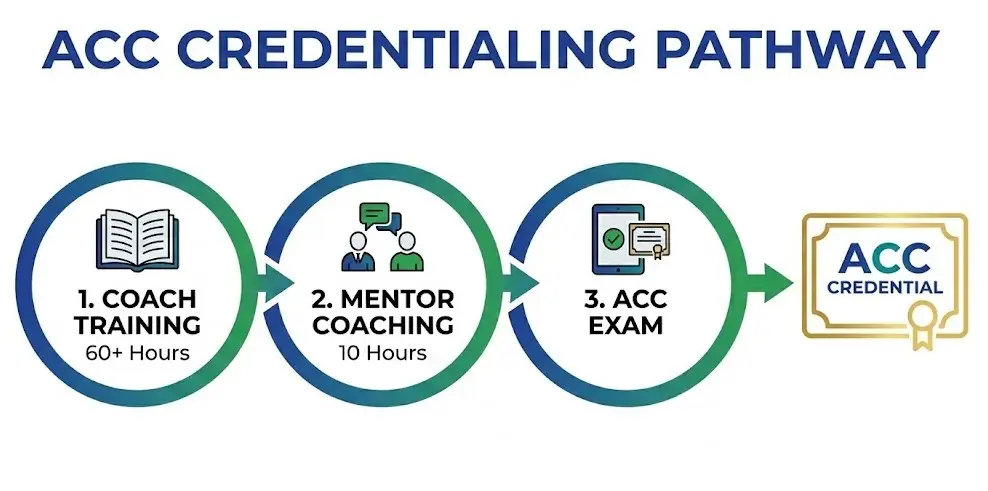
Week 1: Foundations and Coaching Mindset
Focus: Align your thinking with ICF logic
- Review the ICF Definition of Coaching
- Revisit the 8 Core Competencies
- Clarify the coach’s role versus the client’s responsibility
- Practice identifying competencies in short examples
Key focus: understanding what coaching is — and what it is not.
Week 2: Ethics and Professional Boundaries
Focus: Build ethical reflexes
- Study the ICF Code of Ethics in depth
- Focus on confidentiality, dual roles, conflicts of interest, and referrals
- Practice scenario-based ethics questions
Key focus: choosing the most ethical response, not the most convenient one.
Week 3: Applied Competencies and Exam Logic
Focus: Learn how the exam thinks
- Practice multiple-choice questions daily
- Analyze why incorrect answers are wrong
- Avoid advice, fixing, or leading
Key focus: selecting the most ICF-aligned option.
Week 4: Consolidation and Exam Simulation
Focus: Confidence and clarity
- Complete at least one full mock exam
- Review mistakes and recurring confusion points
- Stop intensive studying 48 hours before the exam
Key focus: mental clarity and focus.
Common ICF ACC Exam Mistakes (and How to Avoid Them)
Answering as an Expert Instead of as ICF
Many candidates answer based on experience or organizational expectations.
What to do instead: ask yourself,
“What would ICF consider the best coaching response?”
Choosing the Most Helpful Answer
Advice and solutions often feel right — but are frequently incorrect.
What to do instead: prioritize curiosity, partnership, and client self-discovery.
Underestimating Ethics Questions
Ethics questions are subtle and situational.
What to do instead: choose the option that protects confidentiality and maintains professional boundaries.
Overthinking Simple Questions
Some questions are straightforward.
What to do instead: trust the fundamentals.
ACC evaluates foundational competence.
Memorizing Instead of Understanding
Knowing labels is not enough.
What to do instead: understand intent, behaviors, and impact.
Final Thoughts
The ICF ACC Exam is not designed to trick candidates.
It validates one essential capability:
Your ability to consistently think and decide as an ICF-aligned professional coach.
If your preparation brings clarity rather than stress, you are ready.